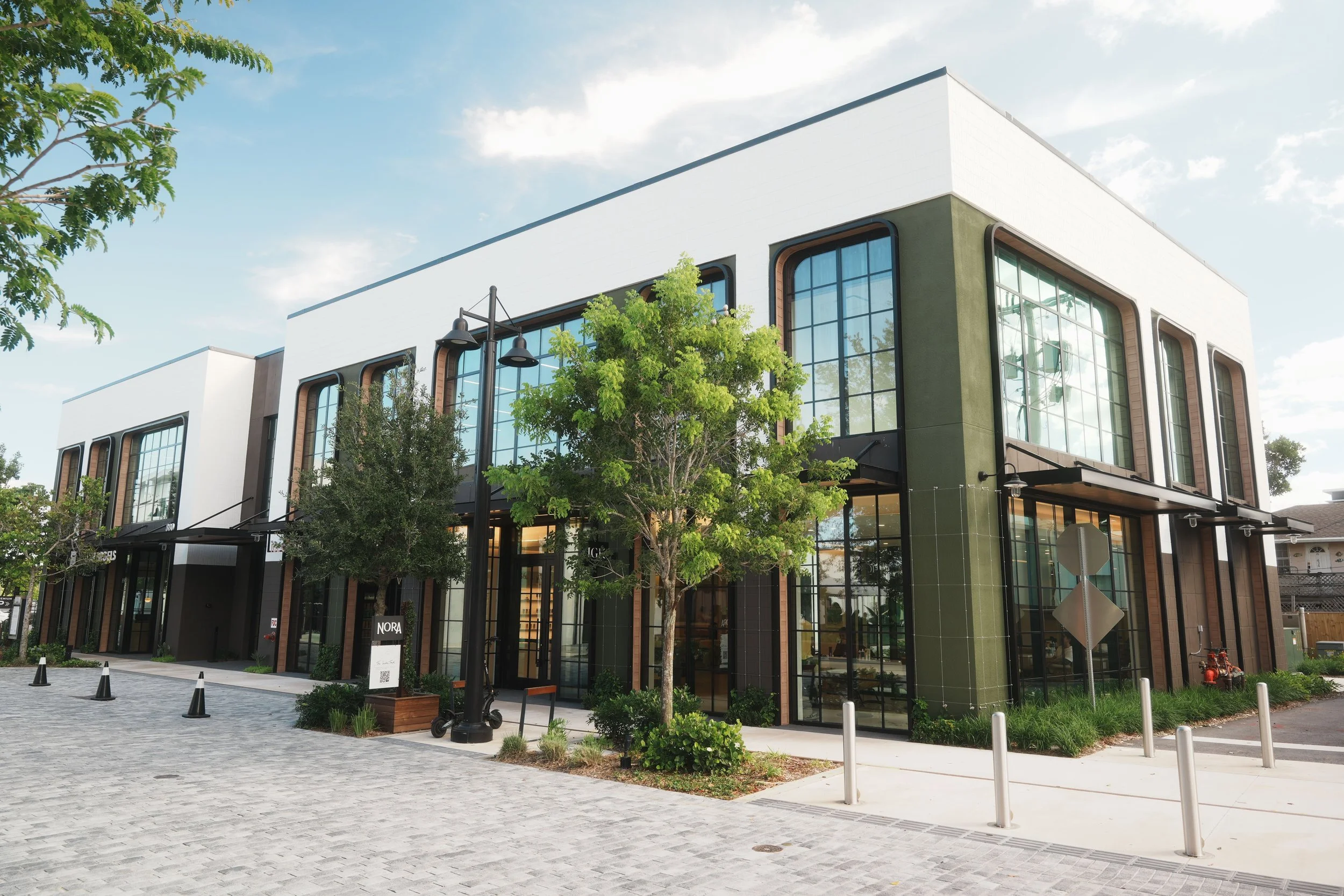
Images credit: Nora District.
Not where anyone was already going
What caught my attention first about Nora was where it is.
It is not downtown. It is not on the stretches people already drive to without thinking about it. It sits north of all that, on a run of old warehouses along North Railroad Avenue, in a part of town that for years gave you no particular reason to turn down it.
That is the hard version of this. Getting people to cross town for you is tough anywhere. Getting them to come somewhere they had no reason to go is harder. Most projects skip that problem entirely. You build where the traffic already is.
This one went the other way, and gave the city somewhere new to go.
Which raises the question I keep coming back to. How do you acclimate to a place well enough to survive in it?
Not how do you stake a claim. Staking a claim mostly takes money. Acclimating means learning a market that does not work like your last one, adjusting when your plan does not land, and staying long enough to find out what the place actually wants from you. Plenty of projects plant a flag. Fewer are still interesting in year five.
Then in September I sat in a founder speaker series at 1909 and heard two of the people behind it talk about how it had actually gone.
They did not have to be as open as they were. They talked about starting with two buildings under contract and ending up with more than ninety properties. Almost two years of beating down doors, a car full of pitch books, false starts with investors who were never going to say yes. Renegotiating every contract in the first week of COVID. A tenant profile now on its third or fourth version. Local operators who got close to the finish line and then walked away. How much harder staffing is here than in the markets most operators arrive from. One of them said, in front of everyone, that they had already shut down their first restaurant.
I have sat in a lot of these rooms. You get the highlight reel. You almost never get the middle.
That openness is why I wanted to write about Nora, and it is not the reason I expected to have. The acclimating question is the one I kept turning over after September, and this is what this write up is about.
Who showed up
Two people sat in front of the room that night. I want to be precise about that, because a project this size has many hands on it and I am not going to pretend I met all of them. These are the two who showed up and answered questions, and one of them later answered mine in writing.
Ned Grace co-founded NDT Development and handles business development, deal sourcing, financing and the firm's direction. Before NDT he and his partners built a property management company and worked across residential, commercial and hospitality in South Florida. Before that, analyst seats at Millennium Partners, Janney Montgomery Scott and JP Morgan in New York.
Joe Furst founded Place Projects in Miami. Before that he was Managing Partner at Goldman Properties, where he was pivotal in turning Wynwood into what it became, and he founded the Wynwood Business Improvement District.
That second background matters here, and not in the way people usually reach for.
Joe's mentor in the business was Tony Goldman, the man credited with the preservation of the historic district in Miami Beach and with Soho before that. Joe worked with him in Wynwood. He told the room that Tony had a set of sayings the team called Tonyisms, and he offered one of them:
“Feed the neighbor, and it will feed you.”
That is the sentence I wrote down and underlined. It is not a slogan about giving back. It is a claim about how this actually works. A project that takes from a neighborhood and returns nothing does not get to stay.
He had the mechanics behind it too. Nobody signs a lease for a block with nothing else on it, so the first push has to come from within. That is what they did in Wynwood, and what Tony did in Soho.
You could see the experience in how he handled the room. The moderator asked him straight out whether these guys are good for West Palm Beach. He did not dodge it. He walked through it, gave his numbers, said where he is not the expert, and finished by admitting that nothing is perfect and there is always a story or two that cuts against what he just said.
I do not have to agree with every number he cited to recognize what that was. He treated a room full of people with reason to be skeptical as capable of handling a real answer.
The detail that told me the most was smaller. Nora went through more than twenty public hearings and Joe does all of them himself, no land use attorney at the podium. His approach with the city is to let staff own the ideas and take pride in the work, rather than be the developer who shows up angry about a permit. They do not get paid much and they hold all the cards, he said. So why treat them badly?
That is feed the neighbor applied to a building department. It is also the least glamorous possible example of it, which is why I believed it.
Where other people see something finished, he said he mostly sees problems and another five years of work. That is why I take the choices here seriously. The expertise on this project is not only in financing and leasing. It is in knowing how a neighborhood feels when something large arrives in it, and being willing to stand in the room and have that conversation yourself.
The ones who study it
Late in the evening somebody asked Ned what surprised him about hospitality while building this. His answer is the whole thesis of this piece, said by one of the people with the most money riding on whether it is true.
“The chains or the operators that come in here and really try to understand the market are going to do a lot better than the ones that just come in here and try to sort of plant their flag. And the people that embrace the local community are going to do the best.”
Study the market, or plant your flag. Embrace the community, or do not. He has watched enough operators try both to know which one survives here.
What makes it more than a nice line is the specifics underneath it.
The education is real, and it was not in the plan:
“Those boutique operators need to understand the market. They need to come study it, and we’re having to help educate them more than we thought.”
Staffing is the one nobody budgets for properly. He said hiring here is a lot harder than in the markets these operators come from, and called it a challenge most of them did not see coming. That bill shows up after the lease is signed, which is the worst time to find out.
They spent real time looking locally. He described operators who got close to the finish line and then said they did not want to do it. He was also direct that nothing local was excluded, that if the best sushi chef in the world turned out to be from West Palm Beach they would have been at the table, and that a good number of their office tenants are local. The people who know this market best were the most cautious about it, and that is worth sitting with rather than explaining away.
And the tenant profile has moved more than once. He said they are on their third or fourth iteration of it, including an early stretch where the plan was to build and operate the restaurants themselves with a few local friends, because no operator signs a lease for a block with nothing else on it yet.
That is the reality of it, and hearing it laid out that plainly was an eye opener.
Inside a neighborhood, not on a street
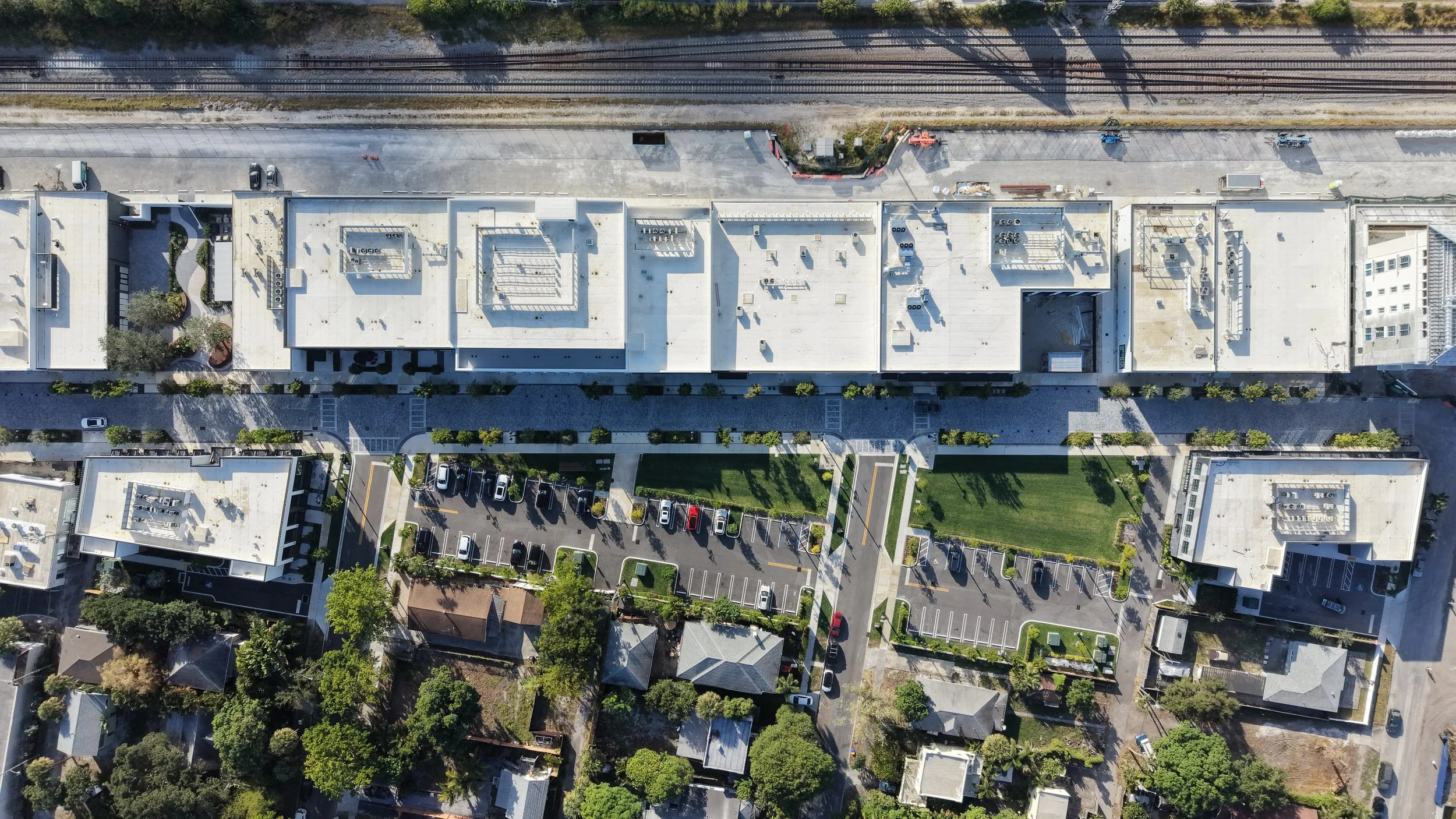
Images credit: Nora District.
Forty acres inside an existing neighborhood is a very different thing from a strip along one road. It is also the part that decides how the neighborhood ends up feeling about you.
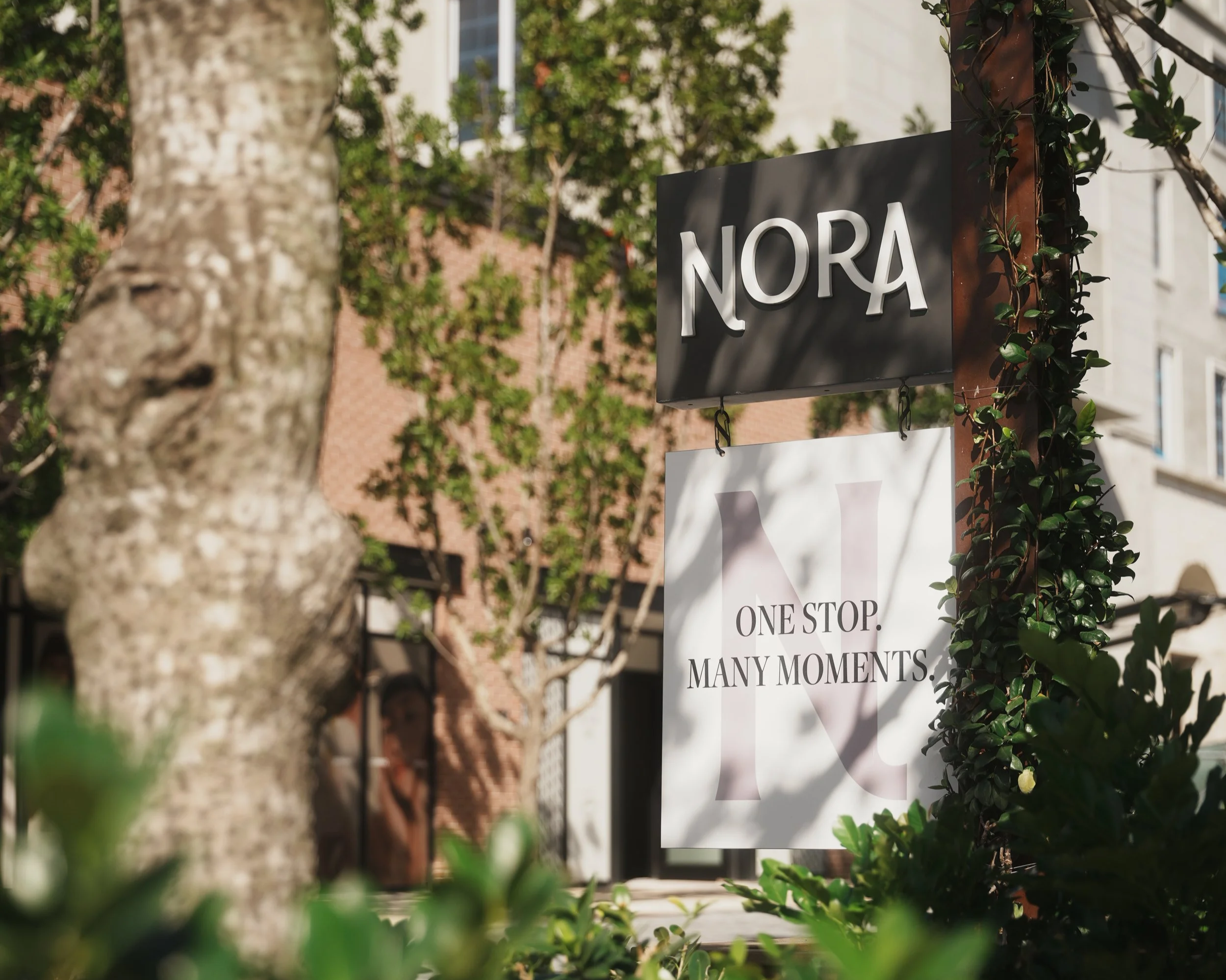
Nora takes its name from North Railroad Avenue. The buildings face the Florida East Coast Railway that Henry Flagler ran through here in the late 1800s. The first one they acquired, 925, dates to 1925 and was most recently a paper storage warehouse.
Here is Ned on what that felt like:
“It felt as if we had stepped onto a movie set. Each building had its own character, and there was something really special about that.”
They kept the character. You can still read the industrial bones of the place, and the branding leans into them rather than papering over them. That work came from Gather and Seek, a studio right here in West Palm Beach, who built the early identity around the warehouse strip, the rail line and the landmarks around it. The studio's founder was in the audience that night, and thanked them for sticking with locals. There are a lot of local hands on this project, and that is not the usual.
There is also the fact that they are landlord and operator at the same time. That is not the headline here, but it explains a lot. When you are the landlord and you also run things inside the building, a tenant failing is not somebody else's problem you can lease around. You feel it. It is probably part of why they were willing to talk about it.
The other thing a neighborhood gets that a corridor does not is a reason to walk. Nora is walkable in the real sense, where one thing leads to the next and you did not plan the afternoon. Ned described the shape of that directly:
“Whether that’s starting the morning with a workout and breakfast, coming back for lunch at Pastis, spending the afternoon getting a facial and doing a little shopping, or meeting friends for dinner and drinks, we wanted to create a neighborhood that fits into people’s everyday lives.”
It reads that way on the ground, and I can say that because I am in this area all the time. I am writing part of this from a table at Sunday Motor Co, and in the time I have been sitting here I have watched families go past, dads out with their kids, people walking dogs, a genuinely mixed crowd of people in no particular hurry. Nobody is passing through on the way to something else. They are spending the afternoon.
That is the part you cannot manufacture and cannot rush. A place either gives people a reason to stay a while or it does not, and you find out which one you built after the opening is over.
And they open the doors to things they did not produce. Earlier this year a past client of mine, the Banyan Dance Festival, held one of its events at Nora. That matters more than it sounds. A place that only hosts its own programming is a development. A place that hands the room to somebody else's audience is becoming a neighborhood.
Iteration is the method, not the mistake
Ned said something on stage that most developers would not say into a microphone:
“We haven’t gotten it perfect, right? We’ve made mistakes, and we’ve already shut down our first restaurant.”
He said it in the same breath as describing the tenant profile moving through versions, which is the right place for it. A concept that does not land. A run that ends earlier than planned. An operator who turns out to be wrong for the block. The easy read is that somebody got it wrong, and sometimes that is true. But inside a district still finding its shape, it is also information, and what matters is what gets done with it. The mix moved. New concepts are coming in. That is the system working rather than the system failing.
Trying to force the thing you first imagined into a place that is telling you something else is not conviction. It is expensive.
And the ground keeps shifting underneath all of us. Taste moves. Technology moves. People move here from somewhere else and arrive wanting something slightly different from what the last group wanted. A plan written three years ago and defended unchanged is not a plan anymore, it is a preference.
What I find genuinely interesting about Nora is that they are holding two things at the same time. They are building for the community already here, and for the one arriving. Those are not the same audience and the obvious move is to pick one. They are trying to find the line between them, and they are adjusting as they learn where it runs.
There is also something worth saying about why it is here at all. Ned could have put this somewhere with an easier story to tell. He addressed that in the room, and it is the most unguarded thing he said all night:
“This is our market. We live here. We built this for ourselves, for our friends, for our community. For our kids.”
He went on to say that the idea of coming in, putting up some splashy thing, making money and getting out is far from reality, and that the first way to support a community is to deliver something good to the people you know and live around. That is a different motive than a return profile, and you can feel it in the decisions.
What is still coming
They described the next phase as activation and community, and called it the big thing still ahead. I asked Ned what that looks like on the ground and how he would know it is working.
“In many ways, the work is really just beginning. Our goal from the start was to create a Main Street first, followed by the hotel, so that people staying at Nora would have an entire neighborhood to explore right outside their door. And we’re still building on that vision.”
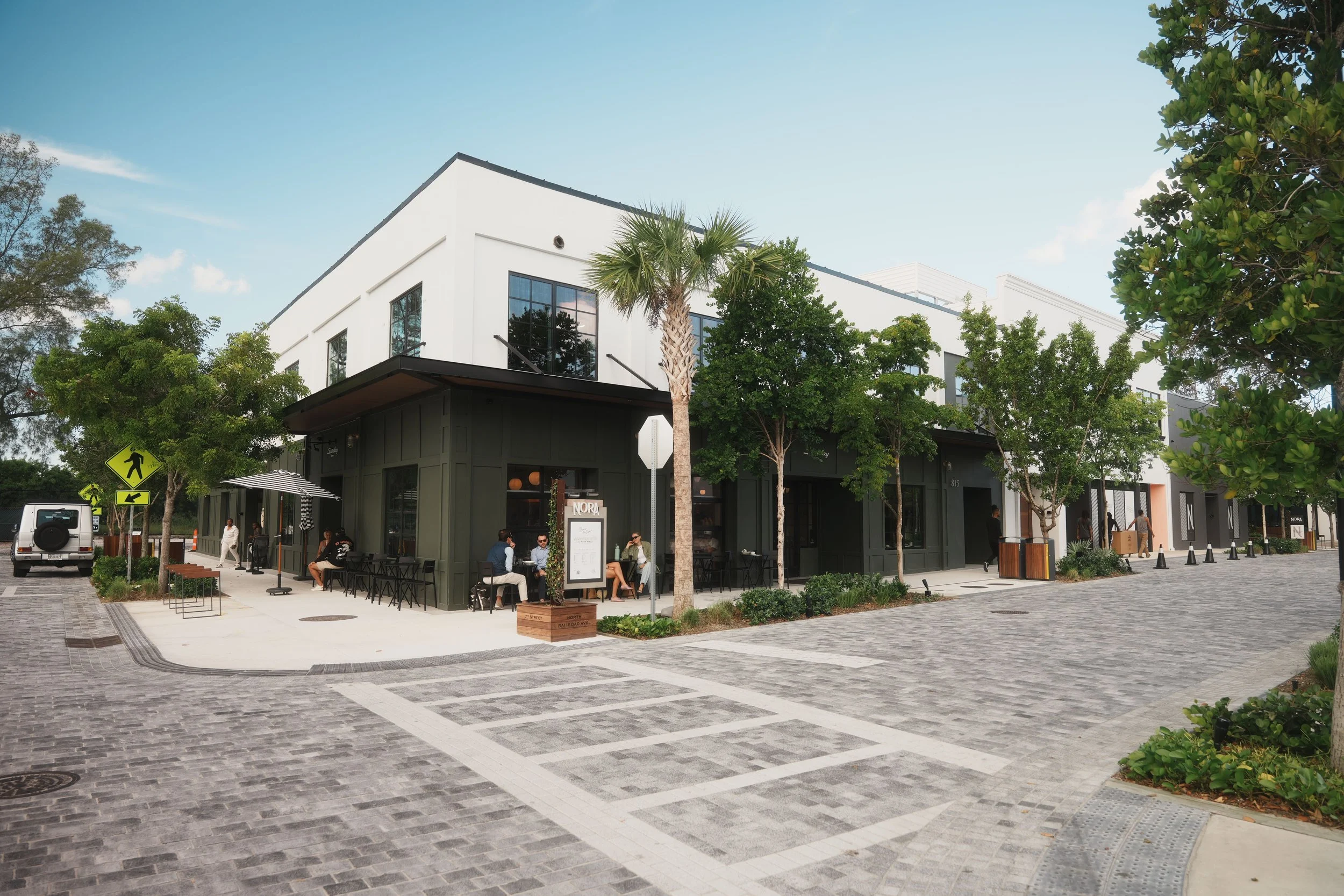
Images credit: Nora District.
He was specific about what that phase involves. The work ahead is activation, philanthropy and community, and he described the team as having spent years in the trenches building the thing and only now learning how to operate it. The hotel is opening in stages, which is itself a decision worth noticing. On October 19 the ground floor came to life. Pastis, Jack's Bar, the main space downstairs. The rooftop was not open yet. The grand opening is November 12.
I was there on the 19th. I had a drink at the Pastis bar and walked through Jack's, and the thing I did not expect to be the story was the staff. They had been trained, and trained well, in a building that had been receiving guests for a matter of hours. Nobody was improvising. That is not luck and it is not hospitality instinct. Somebody invested in it before the doors opened, which is exactly the kind of decision that never shows up in a press release.
Around it, the district has the sort of programming that only works once there is somewhere to gather. Dogs and Dogs. Workouts on the lawn. Residential is coming behind it, along with more office.
His measure of success is the part I would underline:
“For me, the real measure of success is seeing people enjoying the District and making it their own. When you see families spending time together, friends meeting up and people making memories in a place that we envisioned years ago, that’s when you know it’s working.”
Making it their own. Not visiting it. Not posting it. Taking possession of it in the way people take possession of a place they actually use.
I think this next phase decides everything. The buildings are the easy part. Whether a place becomes part of somebody's week comes down to what happens inside it after the opening press dies down, and that is the part nobody can buy.
Does it translate?
This is the question I ask about everything, so I am going to ask it here. A forty acre district with institutional backing is not most of our situations. What survives the trip down to a restaurant group, a festival, a venue, a brand with one location and a good idea?
Five things, I think.
Study the market before you decorate it. The operators who learn the place outlast the ones who arrive certain. This is the cheapest lesson on the list and the most skipped, because studying feels like delay and announcing feels like progress. Who actually lives here. What they already have. What they are driving thirty minutes for. That research is not pre work. It is the work.
Say what did not work, at least internally. A team that cannot name its own misses is a team repeating them. You do not owe the public a post mortem. You do owe your own people an honest room. The version of this I keep seeing is a brand that treats every soft launch as a win and then cannot explain why year two is harder.
Let the thing change. Your first concept is a hypothesis. Tastes move, your neighborhood moves, the people you are serving move. Adjusting is not a loss of nerve, and the brands I watch struggle most are usually the ones defending a plan rather than reading a room.
Hand somebody else the room. The fastest way to stop being a venue and start being a place is to let other people's audiences in. Host the thing you did not produce. It costs you a night of control and buys you a community.
Train the people before you open the doors. The staff at Nora on opening night were not winging it, and you could feel the difference within a minute. This is the same thing I found at Sunday Motor Co, where the culture had clearly been built at the first location and carried intact to the second. Your brand is not your logo or your buildout. On the night it counts, your brand is whoever is standing there when somebody walks in, and what they do in the first thirty seconds. That is a training budget, and it is the one that gets cut first.
And underneath all five, the one I will not stop saying. Your brand is the invitation. Everything that happens before someone walks through the door is doing work whether you designed it or not. The anticipation, the directions, the parking, the first thirty seconds. Nora spent that currency on a neighborhood that feels like it was already there, which is why the arrival does not feel like arriving at a development.
Before you have bought anything
Images credit: Nora District.
The last thing I asked Ned was the question I ask everyone, because the answer tells me what a place actually believes. What do you want someone to feel walking into Nora for the first time, before they have bought anything or spoken to anyone?
“I want people to experience the same excitement we felt when we first discovered the property.”
He did not say impressed. He did not say luxury, or elevated, or any of the words a development usually reaches for. He said he wants you to feel what he felt when he found it.
That is an unusual answer, and it is a generous one. It hands you the founder's own first moment instead of a positioning statement. And it is the whole argument of this piece in one line, because you cannot give somebody that feeling unless you were paying close enough attention to have had it yourself.
The rest of it he said plainly:
“More than anything, we want people to feel that Nora has a real sense of place, somewhere they feel connected to and want to spend time.”
Sense of place is the hardest thing to manufacture and the easiest to destroy. You get it by leaving enough of what was there, by letting other people put their own things in the room, and by being willing to be wrong in public about what belongs.
I have been following this one for years, since before there was much to look at. I was excited when the doors first opened and I am more curious now than I was then, which is not the usual direction. The buildings are up. The hotel is opening. The invitation is the part still being written, and that is the part I will be watching.
Sources and notes: Ned Grace's responses were provided in writing through Levy Public Relations in October 2026 and are quoted verbatim. Quotations from the September 1, 2026 founder speaker series at 1909 are taken from a transcript of the session; light cleanup of spoken filler, no change to meaning. Biographical details are from bios provided by NDT Development and Place Projects. Early brand identity work by Gather and Seek. Restaurant opening and closing dates per Boca Raton Tribune. Hotel background per Afar. Images credit: Nora District